COMPARE
Add product to compare
COMPARE
Add product to compare
Enable Cookies
Our website uses cookies, pixels, and similar technology (“Cookies”) to improve your online experience. By clicking “Accept All,” you consent to our use of all Cookies to personalize your experience, serve targeted advertisements, perform analytics, and for other business purposes. You may block some Cookies by clicking “Reject,” or change your cookie settings by clicking “Preferences.”
By using our website, you acknowledge this notice, and by clicking “Accept All,” “Reject,” or “Preferences,” you agree to our Website Terms of Use. See our Cookie Notice and Privacy Policy to learn more.
You just spent serious money on a premium pair of mountain hunting boots. You hit the backcountry, and by day two, your heels are shredded, your toes are bruised, and your hunt is compromised. Sound familiar?
This is the reality for thousands of hunters every season. If your feet hurt, it's rarely a defect in the boot — it's a breakdown in fit, internal volume, or lacing technique. A premium boot is a precision tool. To get the most out of it, it needs to fit correctly.
Quick Answer
A properly fitted hunting boot feels snug across the midfoot and instep, locks your heel in place with no more than 1/4 inch of lift, and leaves about 1/2 inch of space in the toe box. Order your true-to-size length. Go up in width, not length, if you feel side-foot pressure. Most fit problems — toe jam, heel slip, blisters — trace back to one of three causes: wrong internal volume, loose lacing, or the wrong sock system.
Jump to:
No. Order your normal, true-to-size length. CRISPI® boots are built on over 50 years of Italian boot-crafting experience, and our Dynamic Frame construction is engineered to fit true to size— no oversizing needed to compensate for break-in or foot swelling.
Sizing up might seem like an easy way to create more room for thick socks or end-of-day foot swelling, but it usually creates a different problem. A boot with extra length creates dead space behind the heel. On steep ascents and descents, that space lets your heel lift out of the heel pocket, and the resulting friction is one of the most common causes of blisters and hot spots in the field.
If your length feels correct but you have side-foot pressure or toe crowding, the fix is a wide (EE) width — not a longer boot.
A hunter feels crowding or pressure across the forefoot and assumes they need a bigger size. But length and width solve different problems. Adding length to fix a width issue leaves dead space in the heel cup, which trades one problem (crowding) for a worse one (heel slip). If your true size fits well end-to-end but feels crushed side-to-side, stay at your normal length and move from a Regular (D) to a Wide (EE) width.
About 1/2 inch — roughly a thumbnail's width — between your longest toe and the front of the boot. This gap prevents black toenails and bruising on steep downhill and side-hill terrain, where your foot naturally drives forward with every step.
The causes: most likely the boot is too short, or your midfoot lacks lacing tension. Gravity pulls your foot forward on descents. Without a locked-down instep, your foot slides forward inside the boot until your toes hit the rand.
The field fix: If you've confirmed your boots are true to size, but your toes still slide forward on descents, tie a heel-lock (also called a surgeon's knot) at the point where the eyelets transition to the ankle hooks. This isolates lacing tension over the top of your foot and traps your heel in the heel cup so it can't slide forward, even on steep descents.
Neither. Loose boots create dead space, which causes friction and blisters. Overly tight lacing cuts off circulation, which leads to cold feet. The goal is a secure, wrapped feeling around the ankle and instep — snug, not constricted.
Boot geometry does a lot of this work for you. Select CRISPI® models — including the Nevada, Briksdal MTN, and Lapponia Pro — feature our Ankle Bone Support System (A.B.S.S.), which contours around the ankle structure to lock the joint in place on uneven terrain — support that comes from the boot's structure, not from over-tightening your laces.
Heel slip happens when there's too much internal volume in the boot — often from sizing up — or when your foot isn't seated correctly in the heel pocket. If your heel lifts more than 1/4 inch while walking, that movement causes friction against your sock and skin.
Volume vs. Size: These are two different things. Foot length is your size; foot volume is the height and width of your instep. If your heel is slipping, sizing down isn't automatically the answer — you may just need to reduce excess internal volume through better lacing technique or a structured aftermarket insole.
Fit isn't only about length and width. Boot flex and construction also influence how a boot supports your foot.
A softer-flex boot provides greater flexibility and ground feel. A stiffer-flex boot provides greater structure and support for demanding terrain and heavier loads. A stiffer boot doesn't automatically fit better — it means the boot's flex should match the way you hunt.
Your ideal hunting boot combines correct size, correct width, appropriate internal volume, proper lacing, and appropriate boot flex.
For the full breakdown of CRISPI®'s flex scale, see the CRISPI® Flex Rating Guide:
Many hunting boots ask you to log 50 to 75 miles before they stop hurting. CRISPI® boots are built differently, thanks to our Dynamic Construction — the combination of construction principles built into every CRISPI® boot that's designed to eliminate the traditional break-in period rather than just shorten it.
CRISPI® boots also feature a built-in rocker at the foot's natural flex point, which helps propel you through your stride from day one. If you feel sharp pain, pinching, excessive slop, or tightness right out of the box, that's not something to walk off as "break-in" — it's a signal that the size or model doesn't match your foot shape, and it's worth revisiting fit before logging more miles.
For the full breakdown of how Dynamic Construction works, see The Three Pillars of Dynamic Construction blog article.
Blisters come from friction, heat, and moisture together. If you're blistering, one of three things is happening: your foot is moving inside a boot that's too large, your lacing isn't holding your foot in place, or your socks are trapping sweat, which softens skin and makes it tear more easily.
Catching a hot spot on the trail: Lacing naturally loosens over a long hike. The moment you feel a hot spot starting, stop — don't push on to the next ridge. Take the boot off, check your lacing tension, and re-tie with a heel-lock. If your feet are sweaty, let them air dry, swap in a fresh pair of Merino wool socks, and apply Leukotape® over the sensitive area before it becomes a true blister.
Upgrading your footbed: Most boots ship with a neutral factory insole. If blisters are a recurring problem, a structured aftermarket footbed can help — when your arch collapses under load, your foot elongates and shifts inside the boot. A supportive footbed stabilizes the arch and helps keep your heel seated in the heel pocket, addressing the friction at its source.
Run two tests: the Heel-Gap Test unlaced, and an evening wear test at home with your hunting socks on.
The Heel-Gap Test: Put on your hunting socks and completely unlace the boots. Slide your foot forward until your toes just touch the front of the toe box. You should be able to fit exactly one finger — or about 1/2 inch of space, roughly the same gap you'd see if you pulled the factory insole and stood on it — behind your heel and the back of the boot. If you have significantly more or less room than that, the length is off.
The Evening Wear Test: Lace up your new boots and wear them around the house for a few hours in the evening, when your feet are naturally most swollen from the day's activity. A correct fit feels supportive and comfortable across the instep immediately — no hot spots, no slop, no pressure points.
Wear Merino wool hunting socks. Merino wicks moisture, regulates temperature, and holds its loft under pressure — cotton does none of these things and traps sweat against your skin instead, which accelerates blister formation.
Your boots' GORE-TEX® membrane is designed to push moisture out. Cotton socks trap moisture against your skin before GORE-TEX® can do its job, working against the system you paid for. Sock thickness is also a fit tool: switching between lightweight and heavyweight Merino lets you fine-tune internal volume. If your boot feels slightly loose, a heavyweight sock can close that gap.
Fit isn't one setting — it's length, width, volume, and lacing all working together. Get them right, and you stop thinking about your boots entirely. That's when you're free to focus on the hunt.
| Symptom | Likely Cause | Fix |
|---|---|---|
| Heel slip / lifting | Excess internal volume, often from sizing up | Confirm true-to-size length; apply heel-lock lacing; consider a structured aftermarket insole |
| Toe jam / bruised toenails | Boot too short, or foot sliding forward on descents | Confirm 1/2" toe room with the Heel-Gap Test; add heel-lock lacing to stop forward slide |
| Side-foot pinching, correct length | Width too narrow for foot volume | Move from Regular (D) to Wide (EE) — don't size up in length |
| Blisters | Friction heat moisture from loose fit, poor lacing, or cotton socks | Re-lace with a heel-lock; switch to Merino wool socks; treat hot spots immediately with Leukotape |
| Cold feet | Lacing too tight, cutting off circulation | Loosen to a secure-not-constricted tension; let boot geometry (not laces) provide ankle support |
| Ongoing discomfort after several wears | Fit mismatch, not a break-in issue | Reassess size/width — CRISPI® boots aren't designed to require a lengthy break-in period |
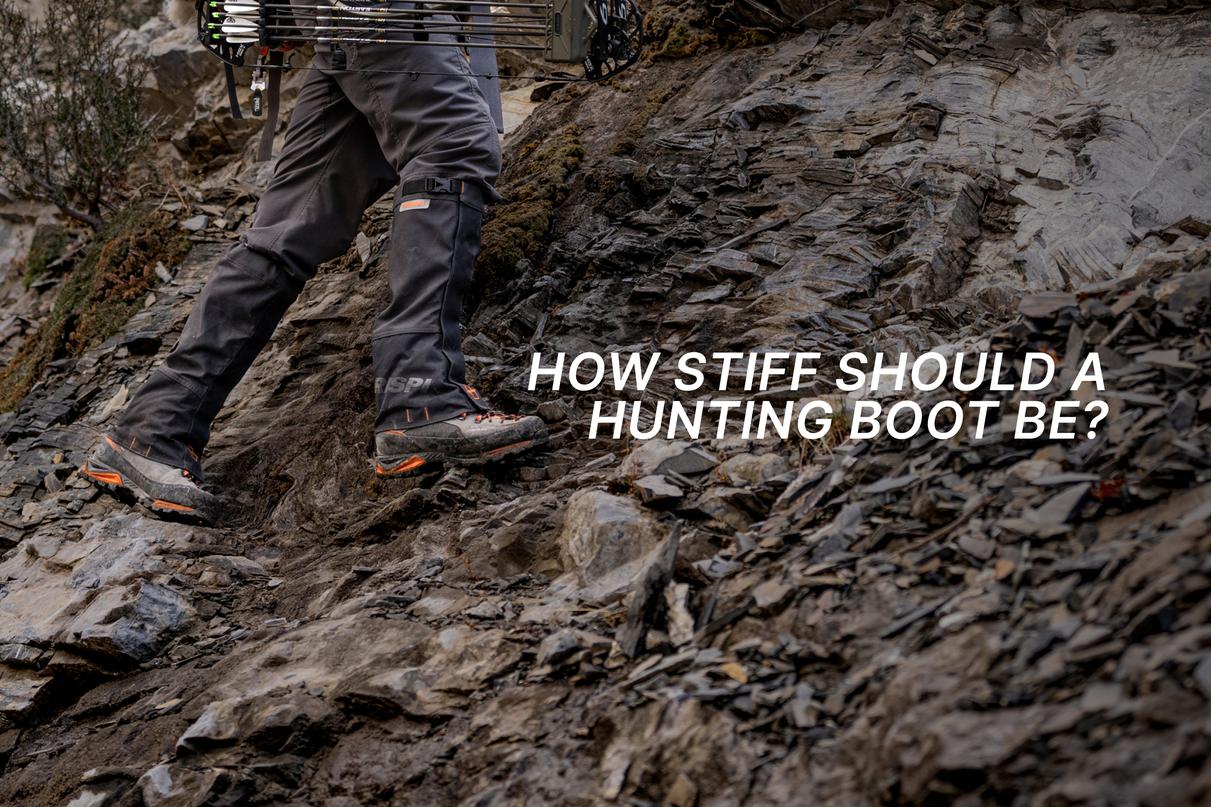
You don't need to understand how a boot is built to choose the right stiffness. You just need to know the terrain you hunt.
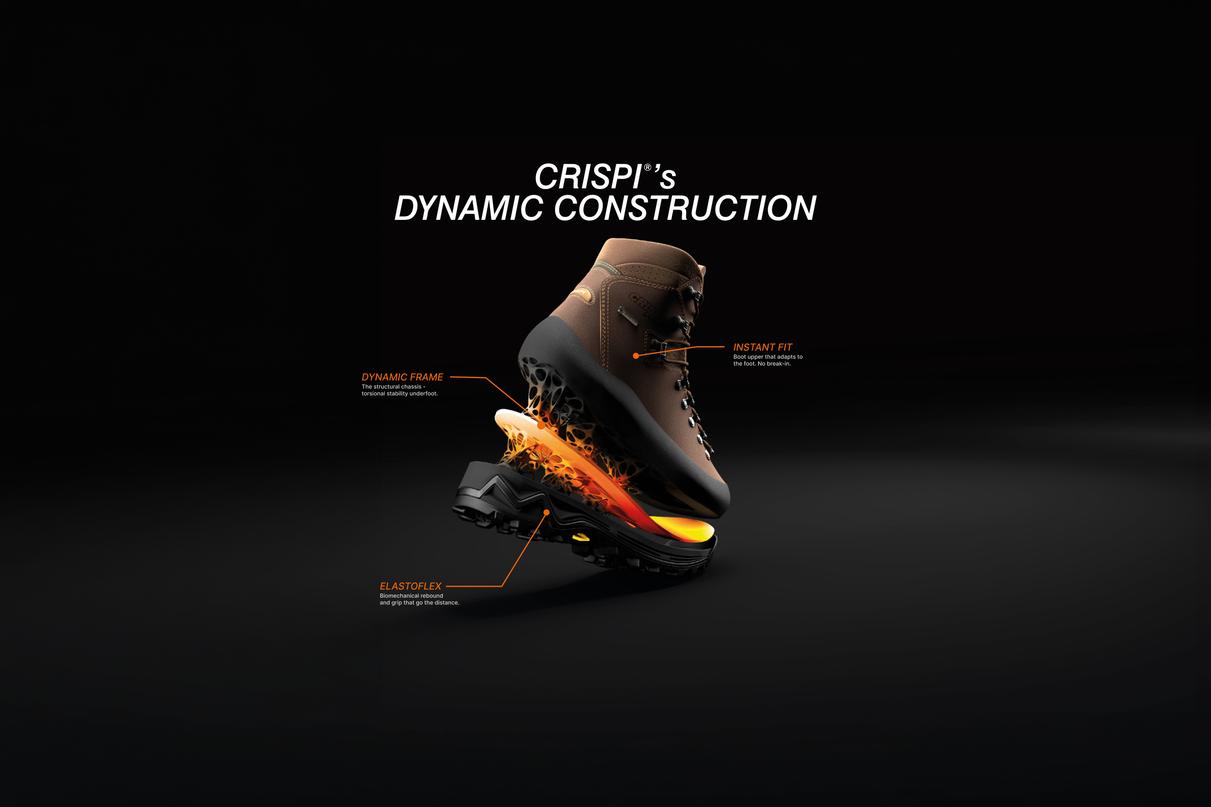
The Dynamic Frame is the foundational "chassis" of every CRISPI® boot. It serves as the essential technical link that bridges the gap between the upper’s comfort and the sole’s performance.
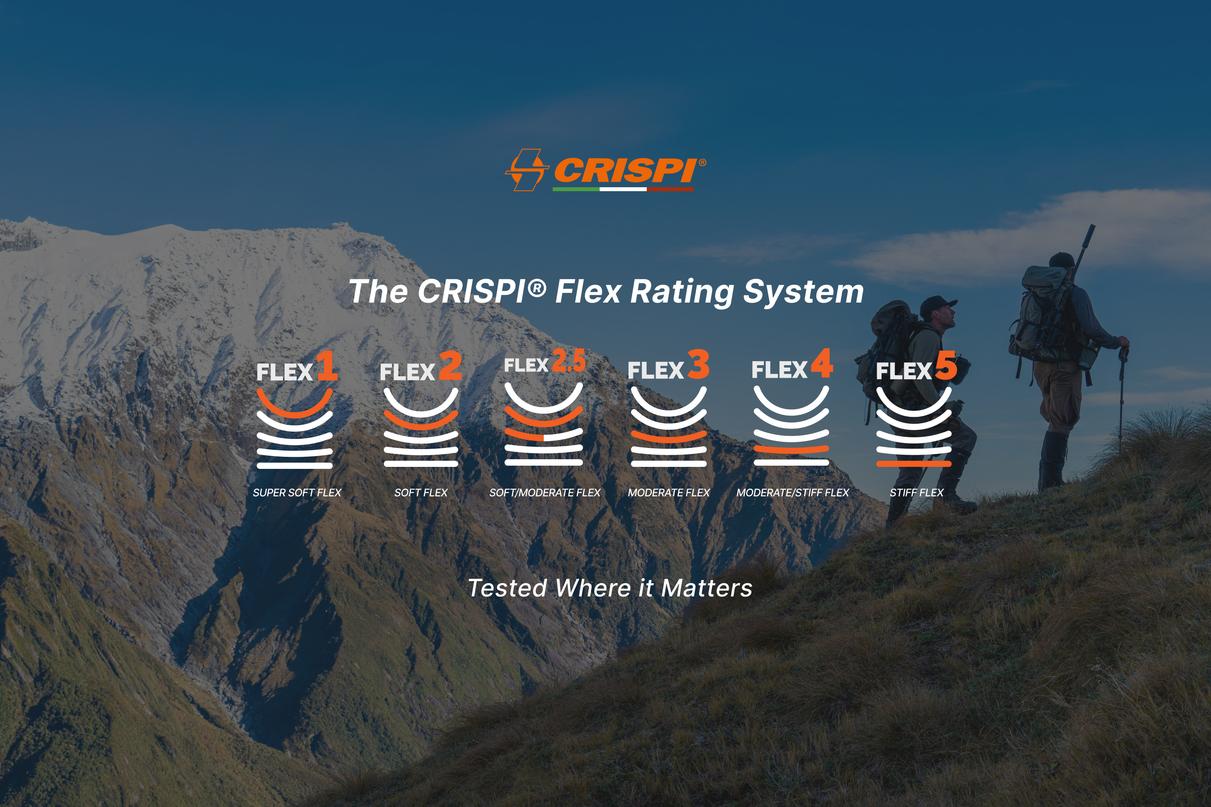
A hunting boot’s Flex Rating describes how stiff or flexible the boot feels underfoot and through its overall support structure.